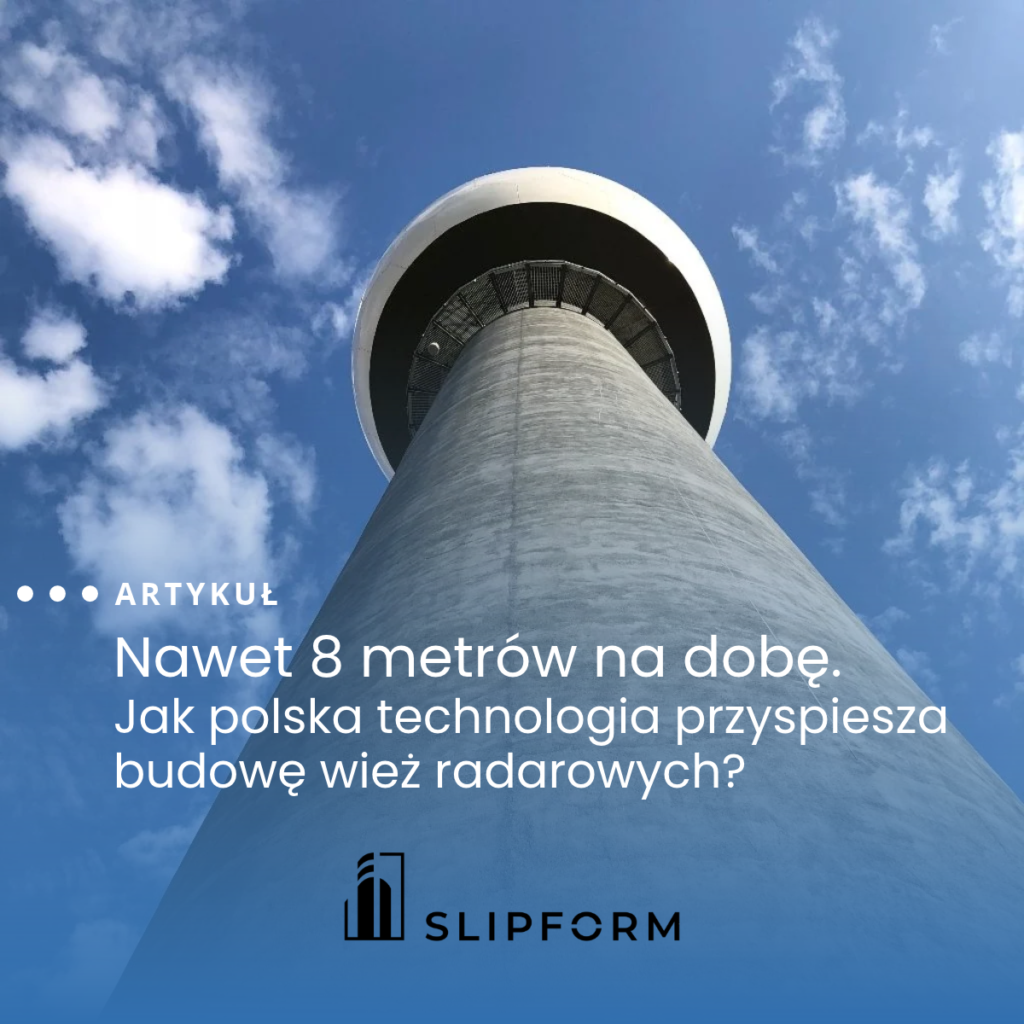
Building a radar tower several dozen metres high does not have to take months. Thanks to slipform technology, reinforced concrete structures can be erected at a rate of up to 8 metres per day. At SLIPFORM, we use this technology in our projects.
Radar towers are an essential part of the infrastructure responsible for airspace safety. They support equipment used to monitor air traffic. These structures must meet stringent technical requirements, ensuring adequate stability and resistance to environmental conditions, including strong winds.
8 Metres in Just One Day
The slipform method is based on a continuous concrete pouring process. Our system, equipped with hydraulic mechanisms, gradually moves upwards as construction progresses. During this process, construction teams install reinforcement, pour concrete and monitor the geometry of the emerging structure.
The process can operate 24 hours a day, seven days a week. Under suitable technical conditions, this allows structures to be erected at a rate of up to 8 metres per day.
This means that the reinforced concrete shaft of a 40-metre tower can be constructed in just eight days of continuous concrete pouring.
However, this does not represent the total time required to complete the entire project, which also includes foundation preparation, installation work, equipment assembly and technical inspections.
Another significant advantage of this method is the monolithic nature of the resulting structure. Continuous concrete pouring reduces the number of construction joints, which is important for the technical performance and long-term durability of the structure.
Radar Tower Construction for the Polish Air Navigation Services Agency, the Institute of Meteorology and Water Management, and the Maritime Office in Szczecin
SLIPFORM’s experience in infrastructure construction includes the completion of six radar towers for the Polish Air Navigation Services Agency (PANSA), ranging in height from 35 to 45 metres.
Our portfolio also includes a 44-metre tower constructed for the Institute of Meteorology and Water Management (IMGW) and a 33-metre structure for the Maritime Office in Szczecin.
These projects demonstrate the practical application of slipform technology in infrastructure construction requiring a high degree of precision.
For structures of this kind, it is not only their height and structural strength that matter, but also the ability to maintain precise geometric parameters throughout their entire height.
Technology for the Infrastructure of the Future
The application of slipform technology extends far beyond radar towers.
The same technology can be used to construct air traffic control towers, telecommunications facilities, industrial structures, and infrastructure related to security and defence.
As critical infrastructure becomes increasingly important, construction solutions that combine rapid execution with stringent technical standards are playing an ever-greater role.